



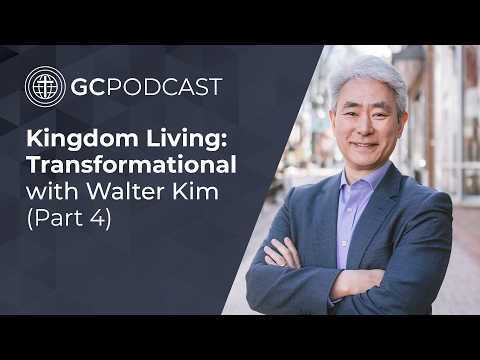
Cara: In 2026, the GC Podcast is shifting to a new format with too miniseries released throughout the year rather than monthly episodes. This change is going to allow us to go deeper into meaningful conversations that support our shared journey of Kingdom Living. In the first half of the year, we’re excited to launch the series with Reverend Dr. Walter Kim, president of the National Association of Evangelicals, and the keynote speaker for the 2026 denominational celebration. In this series, Dr. Kim joins me to explore what it means to live as citizens of God’s kingdom in today’s world — faithful to Christ, formed in community, and engaged in mission. So, stay tuned for this rich and timely series.
[00:00:53] Cara: Hello friends, and welcome to this episode of GC Podcast. This podcast is devoted to exploring best ministry practices in the context of Grace Communion International churches. I’m your host, Cara Garrity, and today we are concluding our miniseries on Kingdom Living with Reverend Dr. Walter Kim. We’re exploring what it means to live as citizens of God’s kingdom in today’s world. What does it look like to live faithfully in Christ, formed in community, and engaged in mission? So, Walter, thank you for joining us today,
[00:01:24] Walter: Cara, it’s always great to have these conversations with you.
[00:01:27] Cara: Thank you. So, for our final episode of this miniseries, we’re going to be exploring the transformational aspect of Kingdom Living. So, becoming more like Christ as we follow him, and allowing discipleship to change our priorities, values, lives as we’re continually formed into Jesus’ image. And so, I want to begin with, what does it mean to become more like Christ?
[00:01:52] Walter: Yeah, I think that’s obviously the central question for the Christian life — growing in Christ’s likeness, bearing the fruit of the Spirit that is reflected not only in Christ’s life, but the ongoing work of Christ. He said an extraordinary thing, that it’s better that I leave and the Spirit come, than I remain.
I mean, to me, it’s crazy, right? How, could that be? And yet, it is the case that Jesus, as always, lives up to his word, that his departure and the gift of the Spirit mean that the very presence of God has moved from a place. At one point, God’s Spirit descends another temple, and then Jesus said, destroy this temple in three days, I’ll raise it up again.
So, clearly the Spirit descended and resided in a special way and in Jesus as God the Son. And now God sent this forwarding address as Jesus returned to his heavenly abode. The forwarding address of the Spirit is, well, to us, the Church. And God’s Spirit now is moved from a place to the person of Jesus, to the people of God — the people of Jesus who reflect Christlikeness in our character, certainly reflect Christ’s likeness in our mission, reflect the character of Christ in the ways that we are salt and light in the world. And it’s in all these ways. It’s not just in personal transformation and character development — love, joy, peace, patience, the fruit of the Spirit.
[00:04:22] Cara: And I really appreciate that. I think that connects back to the earlier conversations we’ve had about it not being living a kingdom life and being a disciple of Jesus is not about just me, myself, and I. But it’s about how are we living in community relationally and also participating in his mission and what he’s doing, not just what we ourselves would choose to be about doing. What is he doing in the world? And so, it’s not just this individualistic pursuit, but it’s very collective.
And it’s very grounded in what is, he already doing? And coming back to I loved what you said. He’s doing so many things even beyond the scope of what we might be looking at in any particular moment. So, I think that’s a really helpful place for us to ground ourselves in. What does it mean to become Christlike? It’s not maybe as one dimensional as we might be tempted to regard it as.
[00:05:28] Walter: Absolutely. Yeah.
[00:05:28] Cara: And so, what when we think about that what might this transformational Kingdom Living ask of us personally, corporately as we are made more and more into his likeness.
[00:05:46] Walter: Yeah. So, you think about the mission of Jesus that he came into this world to proclaim good news, of course, but he proclaimed good news to the poor, right? Freedom for the prisoner, sight for the blind, release for the captives, the year of the Lord’s favor — this mission that he describes picks up on all the aspirations of the Old Testament but also the transformational work of the good news in the New Testament people of God.
And so, yes, it is this personal transformation, but it’s also, we have to ask question, is the community a better place because of the presence of the church? If the church, if you and your local community disappeared, would the church be missed? Because people would go and realize, wow, we didn’t realize just how much the church was instrumental in addressing education issues or in addressing issues of homelessness, but also in providing a place for youth to be. And equipping people to be good faith presence in all aspects of society. Whether it’s how you handle your work, the ways you go about your work in all the different places that God might have people in your church serving and working — that presence of Jesus and it being missed, I think, is a real test.
There have been different seasons in the life and vitality of the church in America and certainly globally, where it’s uncontestable that Jesus and Jesus’ people made a difference, that they were a powerful influence of education. Again, I think of the Sunday school movement and the way that as it was arising in the 1800s as a response to the Great Awakenings and the movement of God’s Spirit and individual transformations, people come from saving faith, but also in corporate transformation as communities were asking, what can we do to be a leavening influence in society?
This was an opportunity for the church to rise up and say, here are all these children working in factories, not getting an education. Why don’t we provide a Sunday school to teach children how to read, how to do math, how to get an education, basically get an education, and of course to teach the truth of who Jesus is.
But it was not just a narrowly defined understanding of what we are doing in Sunday school to build up a church internally or to make sure we have good Christian kids. But it really was this incredibly innovative, creative influence, and offering to society, I think at its best. The church empowered by the Spirit has that kind of creative redemptive influence internally in the shaping of its people, but externally in the transformation of communities.
And yeah, is the community, would the community miss your church’s presence? That’s a really compelling question to ask.
[00:09:36] Cara: Yes. I really like that as a reflective question. I think it helps us to come together and think about, are we living this within our community? Are we doing the things that transformation might ask of us beyond that kind of individualistic thinking about just ourselves and our little corner?
And even just thinking beyond the walls of the church or the already gathering church community. I think that’s a really helpful, and challenging, but also empowering question for us to ask ourselves. And I think that can open a lot of that opportunity, like, that you say, for creativity, even in that — what does that redemptive work look like for us to join into? Because it can look a lot of different ways. Absolutely.
And so, I’m thinking, like, when we think about things like that, like the Sunday school movement or asking ourselves that question about would our neighborhood, would our community miss us If we went away, when we think about becoming transformed or becoming something new in these different kind of creative senses or joining in that redemptive work, it often requires some kind of a change, right? Like transformation is experiencing a change and usually a very dramatic change. And we are usually more comfortable with what we’re familiar with and what we know. So, that can be one of the challenges with allowing ourselves to be transformed. And so, I’m wondering, can you speak a little bit to both the fears, but also the freedoms surrounding transformative change for us as a church?
[00:11:24] Walter: Yeah. Cara, that’s an interesting chicken and an egg challenge, right? In some ways, we need to be transformed first by the Spirit in order to be able to offer anything to the world of substance, of meaning, of truly a different way of living, and life, and a connection to God that speaks to the transcendent power of Jesus Christ. So, on the one hand, it seems like we need to be changed first. And yes, that there is truth to that before we can offer, we need to be transformed, be before we can offer transformation to others.
But in another sense, when we pray, Lord, I’m a little bit stuck in my faith. I’ve read these things and I want to grow. It’s very rarely the case that God’s response would be, “Oh, I had this latest book that you need to read off of the Christian top 10 sellers.” Now that’s a part of the process — of reading, an education.
But oftentimes the Lord throws us into a life-stretching situation that is beyond the transformation that we have experienced, that demands a deeper transformation. How many of us know that it’s when we got a really adverse health situation that all of a sudden, we found ourselves praying? Maybe you read a book on prayer and that really helped your prayer life, and you improved prayer. And again, those things are important. Educate, of course. But there’s nothing like being thrown into a situation where you are desperate because of your circumstances. A lost job, a health diagnosis, something’s going on with kids, a tragedy in your community, a shooting — you name it — natural disaster. These things have a way of expanding and exposing the limits of our faith so that we actually seek a deeper transformation.
So, in some ways it’s a chicken and an egg. Yes, of course, we need to be transformed before we offer transformation. But sometimes the transformation that we offer actually helps us to become transformed, sometimes by going into a community, a neighborhood that you rarely go to in your city. Sometimes it’s building a relationship across a social boundary that makes you uncomfortable. Sometimes it’s having your church try something in the neighborhood that it’s never done before, that actually makes you pray like crazy, search the Scriptures to see is this, really biblical way.
What, how. How can we grow and how can we offer something? That’s a moment in which, if we want to grow in our faith, even from a self-focused point of view, if you want to grow in your faith, putting yourself in these faith-stretching moments are absolutely transformational.
And so, I look at this as the virtuous cycle of Spirit-filled ministry. Yes, we need to be changed in order to offer some something to the world. But sometimes when we step into the world and are stretched beyond our boundaries, we become changed ourselves. What was the way that the disciples began to learn the worldwide mission of Jesus? They saw Jesus talking to a Samaritan woman. It completely stretched their boundaries, put them in a completely, incredibly uncomfortable place as they went back to the Samaritan village and interacted with the Samaritan villagers. That’s exactly, at times I think, the kind of places we need to go if we want to grow in our faith.
[00:15:31] Cara: Yeah. And, as you describe that, I think about even some, again, some of the themes we’ve been talking about, this transformation and Kingdom Living. It’s embodied, right? It’s an experiential thing.
And so, as we’re stepping out in the community, as we’re stepping out into living and discipleship in real time, that part of the process of being transformed is going out and living in the flesh and grappling with some of these things that we’re learning within relationships out in the world, in our communities and figuring out beyond maybe just concepts. What does that look like?
And I like even that example of the Samaritan woman, right? Like you can sit there and maybe read theologies or do bible studies for like weeks and weeks. But until you’re sitting across the table from somebody that you never thought to love that that’s only knowledge in your head. It’s not real. It’s not embodied. It’s not transformation.
And I think that, like, when knowledge becomes lived, that’s when we really step into that kind of area of transformation. And one of the ways I like to think about, too, when we step into those situations where it’s like we’re really stretched is, oh, I’ve hit the end of myself, right? This is very clearly beyond what I know, what I can handle, what I can understand. And so, like, I have to step into this, newness. Because there’s nowhere else. There’s nowhere else to go. And I think those are two ways that going out and living in community can be part of that transformation.
You find the end of yourself, and you find yourself in situations where like knowledge becomes live. And I like what you say too about the chicken and the egg, because I do think. sometimes. we get a little bit in our heads about, okay, we have to be transformed first. And then we can go out. And I think that stops us a little bit from going in and doing the things. But even neuroscience, right, tells us that sometimes it’s in doing the things that we become change. that our minds change. The renewing of the mind and sometimes in that physical embodied participation is, like, part of the process of becoming new.
[00:18:19] Walter: Yeah, absolutely. There is, yeah. I think about how much Jesus in his training of the 12, just threw his disciples out into situations. He sent them out two by two and told them only take your staff and your cloak and go and ask for lodging. These are, like, incredibly faith-stretching moments. And he sent them out before they were even fully able to understand who Jesus is and his full mission.
And so, there is a way in which, again, we perhaps need to trust that as we put people in faith-stretching moments they actually become more engaged as disciples. They learn to embody and live out, but they also learn the limits so that they come back and say I actually discovered, I don’t really know how to answer these questions.
Cara: Yeah.
Walter: I remember when I was working in campus ministry in early parts of my ministry, one of the things that we would do is we would go out with students and share our faith. And there was only so much training that you can do. You can give all the worksheets on how do you answer this question about the Bible, or did Jesus really rise from the dead? Or, what happens to those people who have never heard about Jesus? And you have all these kind of training opportunities, but there is nothing that can replace an actual conversation where you’re unfolding these lessons and then you realize, I remember reading about this, but I actually don’t remember what I read, or that’s a question I’ve never encountered before, or asked in a way that I gave an answer and it really wasn’t satisfactory. And you go back and you realize, I actually need to search the Scriptures even more deeply.
And so, once again, there are ways in which we need to be changed and sent out. There are ways in which, as we repeat and like an athlete make good habits, that we get this more deeply ingrained. But there are also ways in which when we go out to serve the Lord in a variety of faith-searching context, we actually learn our ignorance.
And we become incentivized to say, I really need a better answer. This answer I thought was a good answer. It was satisfactory to me, but actually, it’s not a very convincing answer to a lot of other people that I’m interacting with. I actually need to search the Scriptures some more. I need to find this resource. I need to pray more deeply. I need to fast because this thing is not going to happen unless I engage more deeply in the spiritual battle. There are all sorts of ways that I think we become aware of our need to grow when we’re in these situations.
And, of course, there’s an issue of wisdom here. You don’t want to throw people into situations that they’re going be overwhelmed and completely unprepared for, and you know that’s not responsible leadership. But on the other hand, there’s a little bit of life and courage that we need to have in just going and doing and trusting that the Lord is present and in that will grow us.
[00:21:59] Cara: Thank you. Yeah, that’s very helpful. And those are, I think meaningful insights for us and to challenge how we think about even, like, what does it look like to be disciples in community with one another and in our community? And so, I think as we start wrapping up this conversation. How do we cultivate these spaces and communities that welcome in this kind of transformation that you’ve been suggesting to us and describing for us?
[00:22:38] Walter: Yeah. I think we can take any given issue and find a way to turn that into an opportunity for a corporate, not just an individual, but for a corporate way of faith steps.
So, for instance, it might be a personal evangelism. What would it look like for a church to say together, all of us, whether it’s a hundred or a thousand people attending your church, all of us are going to think of three people and in our small groups or with someone else, we’re going to actually share the name of three people that we in this coming year are praying actively to have a conversation of faith about. And we’re going to name that and we’re going to pray together and hold each other accountable.
I think of a beautiful story that really hits home for me. We did this in our church when I was pastoring back in Boston. My wife and I were both serving as pastors, and we led something called the Lenten Discipleship Institute. So, during the season of Lent, we in invited the church to gather together to go through a specifically designed series of lessons on some aspect of discipleship. And that particular year it was on faith and evangelism and sharing our faith in a holistic way. One of the exercises was to do this very thing, name someone and in your small group share that name.
My wife selected her mom, and we had been praying and seeking to diligently share our faith with her mom for decades. And the Lent and Discipleship Institute gave her a chance to name this person publicly, to talk with a group of people who would have the commitment to be praying for one another during, specifically during this season of Lent.
And then out of the blue during Lent, her mom calls her. My wife’s mom calls her and says, I’ve been thinking, I’ve been thinking about Christianity. And she started asking all sorts of questions.
Cara: Wow.
Walter: Do you need to read the whole Bible before you become a Christian? I heard about this thing about tithing. And the only framework she had — this is what I mean, of sometimes you don’t even know how people think about the Gospel until you actually end these conversations. She thought that that was a membership fee. So, do I have to tithe that in order to become a Christian — it’s like a country club thing where you pay a membership fee and then you can join the club? Is giving to the church like that, a membership fee, so I can’t become a Christian until I become a member, and I can’t become a member until I pay this fee? Is that what you know, Christians are doing? Like, it would’ve never dawned on our mind that anyone would think of tithing as a membership fee, like a country club.
But if you grew up in a world where you don’t have any other frame of reference of what, where else do you join things? Country clubs, and you pay interest. All that is to say sometimes we can take a specific issue, name it, join together corporately, pray for one another, and to see what the Lord might do.
And you can take this on any issue: poverty alleviation, challenging with the whole issues of the homelessness, choosing to volunteer together, being involved with the public education system. What does it look like for us to provide backpacks for students?
Our church, we also sought to run the first science fair for a local public school.
Cara: Wow.
Walter: Because our church had a number of people in the world of science and technology, we partnered with this local public school who had never had a science fair. So, we said, you know what? What if we brought over, like, 50 of our people to run booths and experiments and everything from here’s the very program that Pixar uses to make animation and show that; had aerospace person talk about building the most optimized paper airplane and running experiments. It’s just an amazing opportunity to build relationships.
I would say you could just pick an issue and as a church take a step of faith and try something and see where the Lord might lead you.
[00:27:40] Cara: Thank you. That is, I think, a really beautiful insight and a great place for us to wrap up this series and to have an invitation and exhortation for us to live in a way that embodies the liveliness, the beauty, the mission-drivenness of the kingdom. So, I want to thank you so much, Walter, for joining us for these conversations and for sharing your insights and your life experience, and just your words of wisdom with us.
And so, as we wrap up, I would just ask, would you pray for us one last time and for our members and our community members and leaders and just everyone that our folks and listeners will come in contact with?
[00:28:32] Walter: Yeah.
Lord, we give you praise that the mission is yours and we get to participate in it; that you have created us to be renewed in Christ, made in his image, and sent on his mission; that you have moved your Spirit’s presence from a place to a person now to a people. And that even now your Spirit is working beyond this people and you’re inviting us to participate in that.
Thank you that we know how the story ends. We know that there will be a new heavens and a new earth, and every aspect of the cosmos will be redeemed, renewed for your purpose and your glory. And as we labor imperfectly, as we labor with hope and fits and starts, help us to trust that our labor is not in vain, and that it will find and bear its fruit in due time, and that above all things, the love of Jesus means that we can serve you with great confidence and courage and not a spirit of fear or timidity. And we pray all this in the name of Jesus. Amen.
[00:29:55] Cara: Amen.
So, as we wrap up this series, just a reminder for you all that Kingdom Living is participatory, it’s relational, missional, and transformational. And Jesus said, as the Father has sent me, I am sending you. As citizens of the kingdom and co-laborers with Christ, we’re sent into the world to reflect his light.
Kingdom living requires awareness of our calling and our context, seeing our neighbors’ vocation, and even our sufferings as places where Jesus reigns and sends us. Kingdom Living is not passive. It is a bold proclamation and a tangible demonstration. We not only speak of the reign of God, we show it. Our words align with our works. As image bearers, our relationships become a visible witness to the reality of the kingdom being ushered in. And so, till next time, folks, keep on living and sharing the Gospel.
Thanks for listening. We would love to hear from you. Email us at info@gci.org.